House Edge Explained: Your Key to Smarter Real Money Gaming
Let's be honest. We all want to win. But before you spin that slot or place that blackjack bet, you need to understand the house edge. It's the single most important concept in real money gaming.
Ignore it, and you're playing blind. Understand it, and you make smarter choices. I've seen too many players focus only on big jackpots. They forget the math working in the background.
What Exactly Is the House Edge?
In simple terms, the house edge is the casino's built-in profit margin. It's a percentage of your bet that the game expects to keep over an infinite number of plays.
Think of it this way. If a game has a 5% house edge, it will theoretically keep $5 for every $100 wagered over time. This is a long-term average. Short-term results vary wildly.
That's the key. You can win a session. You can win a week. But the edge ensures the operator always profits in the end. It's how the business stays alive.
House Edge vs. RTP: Two Sides of the Same Coin
These terms are directly linked. RTP, or Return to Player, is the flip side of the house edge.
A game with a 96% RTP has a 4% house edge. The math is simple: 100% - RTP% = House Edge%. So a 97% RTP means a 3% edge. Every percentage point matters to your bankroll.
Always check the RTP. Reputable game providers publish it. If you can't find it, be suspicious. For practice, you can try some free slots no download Canada offers to see RTP in action without risk.
How House Edge Varies Across Different Games
Not all games are created equal. The edge differs massively. Your choice of game is the biggest decision you make.
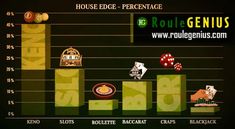
Blackjack with perfect basic strategy can have an edge below 1%. Some slot machines can have an edge over 10%. That's a huge difference in your expected loss rate.
Here's a rough guide from my experience:
- Blackjack (with strategy): ~0.5% edge. The best odds in the house.
- European Roulette: ~2.7% edge. The single zero makes a difference.
- American Roulette: ~5.26% edge. The double zero is costly.
- Video Poker (full-pay): Can be under 0.5%. Requires perfect play.
- Slots: Typically 2% - 10%+. Always check the RTP.
- Keno/Lottery: Often 25%+ edge. Pure entertainment, not strategy.
Can You Beat the House Edge?
This is the million-dollar question. The short answer is no, not consistently in the very long run. The edge is mathematically guaranteed.
But you can minimize its impact. Choose games with the lowest edge. Master strategy for games like blackjack or video poker. Manage your bankroll ruthlessly. This turns gaming from a pure luck activity into a skilled pastime with better odds.
Some ask, can you be a professional slot player? Frankly, it's incredibly hard due to the house edge. Table games with skill elements offer more potential for skilled play.
Banking Methods and Your Bottom Line
Your choice of payment method can indirectly affect your effective bankroll. Fees and speed matter. Here's a typical overview.
| Method | Min Deposit | Max Withdrawal | Speed | Fee |
|---|---|---|---|---|
| Credit Card | $10 | $5,000 | Instant / 1-3 days | Usually free |
| E-Wallet | $10 | $10,000 | Instant / 24 hours | Usually free |
| Bank Transfer | $20 | No limit | 3-5 business days | Possible bank fee |
| Prepaid Voucher | $10 | $5,000 | Instant / 1-3 days | Purchase fee may apply |
The Mobile Gaming Experience and Fairness
Does playing on a phone change the odds? Absolutely not. The RNG and game math are identical. The house edge remains the same on any device.
The mobile experience is about convenience. You can play anywhere. The touch interface is smooth. Modern games are built for smaller screens.
Our Final Take on the House Edge
Respect the math. The house edge isn't your enemy—it's a reality. Your goal isn't to eliminate it. That's impossible.
Your goal is to choose games with a lower edge. Play them correctly. This stretches your entertainment budget. You'll play longer. You'll have more fun.
See the house edge for what it is: the price of admission for the thrill of the game. Pay a fair price. Play smart.